

The problem in one sentence
You can no longer tell whether an image, video or audio clip is real by looking at it.
That used to be a niche concern for newsrooms and forensic analysts. Generative models made it everyone's problem. A convincing fake costs nothing to produce and seconds to distribute. The traditional fixes, reverse image search, pixel-level forensics, detector models, are all reactive, probabilistic, and in a losing arms race against the generators.
C2PA takes the opposite approach. Instead of trying to detect fakes after the fact, it attaches verifiable provenance to real content at the source.
An open standard, not a vendor
C2PA stands for the Coalition for Content Provenance and Authenticity. It is an open technical standard for cryptographically signed metadata that travels with a media file and records its origin and edit history. The consumer-facing brand for it is Content Credentials, the name you will see in Adobe products, on OpenAI's generated images, and on the verification site.
The coalition is not a startup or a single vendor. It is a joint effort hosted under the Linux Foundation's Joint Development Foundation, with founding and steering involvement from Adobe, Microsoft, Intel, the BBC, Truepic, Sony, Google, OpenAI, Meta and Amazon, among hundreds of member organisations. The current published specification is version 2.x, iterating steadily since the first public draft in 2021.
Three parts, signed and tamper-evident
A Content Credential, formally a C2PA manifest, is a signed data structure embedded in, or stored alongside, a media file. It has three core parts.
- Assertions
- Individual statements about the content: how it was created (camera model, capture time, software used), what was done to it (cropped, colour-adjusted, AI-generated), or custom data. Each assertion is a discrete claim about the asset.
- A claim
- Bundles the assertions together with metadata about the signer and references to any ingredient manifests, the provenance of earlier content that fed into this one. The claim is the unit that gets signed.
- A claim signature
- A cryptographic signature over the claim, produced with an X.509 certificate. This is the part that makes the manifest tamper-evident.
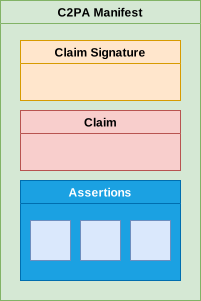
The mechanism is standard public-key infrastructure, the same PKI that underpins HTTPS. Notably, it is not blockchain. The signature covers both the claim and a hash of the asset itself, so any modification to the content or the manifest after signing breaks the signature, and a validator can detect that something changed. When content is edited by a tool that also supports C2PA, the editor can sign a new manifest that references the previous one as an ingredient, building a verifiable chain of edits rather than overwriting history.
The limits
Three constraints worth being precise about before treating Content Credentials as a guarantee.
- It does not prevent removal
- By design, anyone can strip the manifest out of a file. C2PA proves authenticity when the credential is present and valid. It does not stop someone from deleting it. A stripped file is not proven fake; it is unverifiable.
- It does not detect AI on its own
- It records what the creating tool declares. If an image generator chooses to label its output as AI-generated in the manifest, that is captured. A model that does not write a manifest leaves no trace. C2PA is a declaration-and-verification system, not a detector.
- A signature is not truth
- A valid signature means the content came from the signer it claims to and has not been altered since signing. A signed photo of a staged scene is still a staged scene. Provenance is about chain of custody, not truth.
Understanding these limits is the whole game. C2PA shifts the question from "is this fake?", unanswerable at scale, to "can this be traced to a source I trust?", answerable cryptographically.
For developers: the tooling is in Rust
The reference implementation is c2pa-rs, the official Rust SDK from the Content Authenticity Initiative. It lets a desktop, mobile or embedded application create and sign manifests, embed them into supported file formats, and parse and validate manifests it finds. There are C bindings for other languages, and the behaviour is consistent across them because they all wrap the same Rust core.
For quick experimentation there is c2patool, the command-line tool. Reading the credentials on a file is as simple as pointing the tool at it; it prints the manifest as JSON. Signing requires a manifest definition, a JSON file describing your assertions, plus a signing certificate. The tooling ships with test certificates for development, and warns you when you use them, because they are not meant for production.
- Manifests can be embedded or sidecar. The default is to embed the manifest store in the asset, but the SDK can also return it for a separate sidecar file or a remote service. Not every file format supports embedding, so sidecars matter.
- Certificates cost money and require trust decisions. The standard and tooling are free, but production signing certificates run roughly fifty to five hundred dollars a year, and what makes a signature meaningful is whether its certificate chains back to a trust list a validator recognises. The coalition runs a conformance programme and trust list for exactly this.
- Forward compatibility is part of the spec. Implementations are expected to handle unknown assertions and newer constructs gracefully rather than fail, so the format can evolve without breaking older validators.
If you are integrating, the realistic decision tree is: sign at the point of creation if you control it, validate on ingestion if you host content, and surface the credential to users if you display it.
For companies: from optional to expected
Two forces are pushing C2PA from nice to have toward expected.
- Adoption
- It is already shipping. OpenAI embeds Content Credentials in its generated images and video. Adobe's Creative Cloud apps write them. Camera makers such as Leica, Sony and Nikon can sign photos at capture time, which matters enormously for newsrooms and any workflow where the original source is the point. When the tools your customers already use emit C2PA data, supporting it stops being optional.
- Regulation
- The EU AI Act includes transparency obligations for AI-generated content, and C2PA is positioned as a primary technical mechanism for satisfying disclosure requirements. For any company operating in or selling into regulated markets, how to mark AI-generated media is becoming a compliance question with a standards-based answer.
The practical implication: provenance is shifting from a feature you might add to an infrastructure layer you are expected to handle, closer to how TLS went from optional to assumed.
Provenance, not proof of truth
C2PA is not a fix for misinformation, and treating it as one will get you burned. It cannot force bad actors to sign their content, it cannot stop credentials from being stripped, and a valid signature never vouches for truth, only origin and integrity.
What it is, is the most credible, broadly backed attempt to make provenance a verifiable property of digital media instead of a guess. In a world where generating convincing fakes is free, the durable value is not in detecting every fake. It is in being able to prove what is real. That is a smaller claim than the headlines make, and it is also the one that is likely to stick.
Primary sources
Spec versions, tooling releases and adopter lists change frequently. Check the primary sources before relying on specifics.