

Why it is landing on your desk
Three things are true at the same time, and together they explain the timing. Each is sourced below.
AI is arriving faster than the decisions about it. Gartner projects that 40% of enterprise applications will feature task-specific AI agents by the end of 2026, up from less than 5% in 2025 (Gartner, August 2025). Most of that arrives through the side door, in software you already bought: a copilot in the IDE, an assistant drafting customer replies, a vendor whose product added an AI feature in its last release. You did not train any of it. You are still accountable for all of it.
Much of it is already running unsanctioned. In a Gartner survey of 302 cybersecurity leaders, 69% of organizations suspect or have evidence that employees use prohibited public generative AI tools, and Gartner predicts that by 2030 more than 40% of enterprises will experience a security or compliance incident tied to shadow AI (reported November 2025). IBM's 2025 breach research put a number on the consequence: shadow AI was a factor in roughly one in five breaches and added about $670,000 to the average breach cost.
And now someone is asking you to prove it. This is the part that turns governance from a someday project into a this-quarter one, and it is usually a customer rather than a regulator. Vanta, describing why it built an AI assessment product, puts the demand plainly: "We hear from customers and prospects often who are looking for guidance to prove and demonstrate AI compliance and best practices" (Vanta). The question arrives on a security questionnaire, and it is some version of: what AI do you run, what can it reach, and who approved it?
The NIST AI Risk Management Framework matters right now because it is the language that question gets asked in. When a buyer asks whether you are "aligned to the NIST AI RMF," they are not asking for a certificate. They are asking whether you can answer at all.
Small or large, the same four questions
This is not enterprise-only work, and NIST says so itself. The framework is intended for voluntary use and is designed, in NIST's words, "to be flexible and to augment existing risk practices." It prescribes no headcount, no tooling, and no document set.
NIST does acknowledge the difference in capacity directly. From the framework itself: "small to medium-sized organizations managing AI risks or implementing the AI RMF may face different challenges than large organizations, depending on their capabilities and resources."
That is the honest version. The four questions do not change with headcount. What changes is the machinery you need to answer them:
- A small organization has a short list and no dedicated compliance function. Its exposure is usually a handful of tools and a few vendors, which makes the questions answerable quickly, and makes the gap easy to close before it becomes structural.
- A larger organization rarely lacks process. It lacks a single accountable view. Procurement knows the contracts, IT knows the integrations, individual teams know the actual usage, and no one holds the whole picture.
The four questions are the same at every size. What varies is whether you can answer them from a document, or have to answer them from a system.
What it is and is not
The AI Risk Management Framework 1.0 (NIST AI 100-1) was published on January 26, 2023, at the direction of Congress. It is voluntary. It is not a certification. There is no auditor who can make you "NIST AI RMF certified," and any vendor implying otherwise is selling something that does not exist.
This trips people up, because certification exists elsewhere in the standards world and the instruments get conflated. The AI RMF is not one of them. It gives you a way to think, and leaves the proving to you.
What it gives you instead of a certificate is a shape. And the shape turns out to be more useful, if you take it seriously.
Four functions
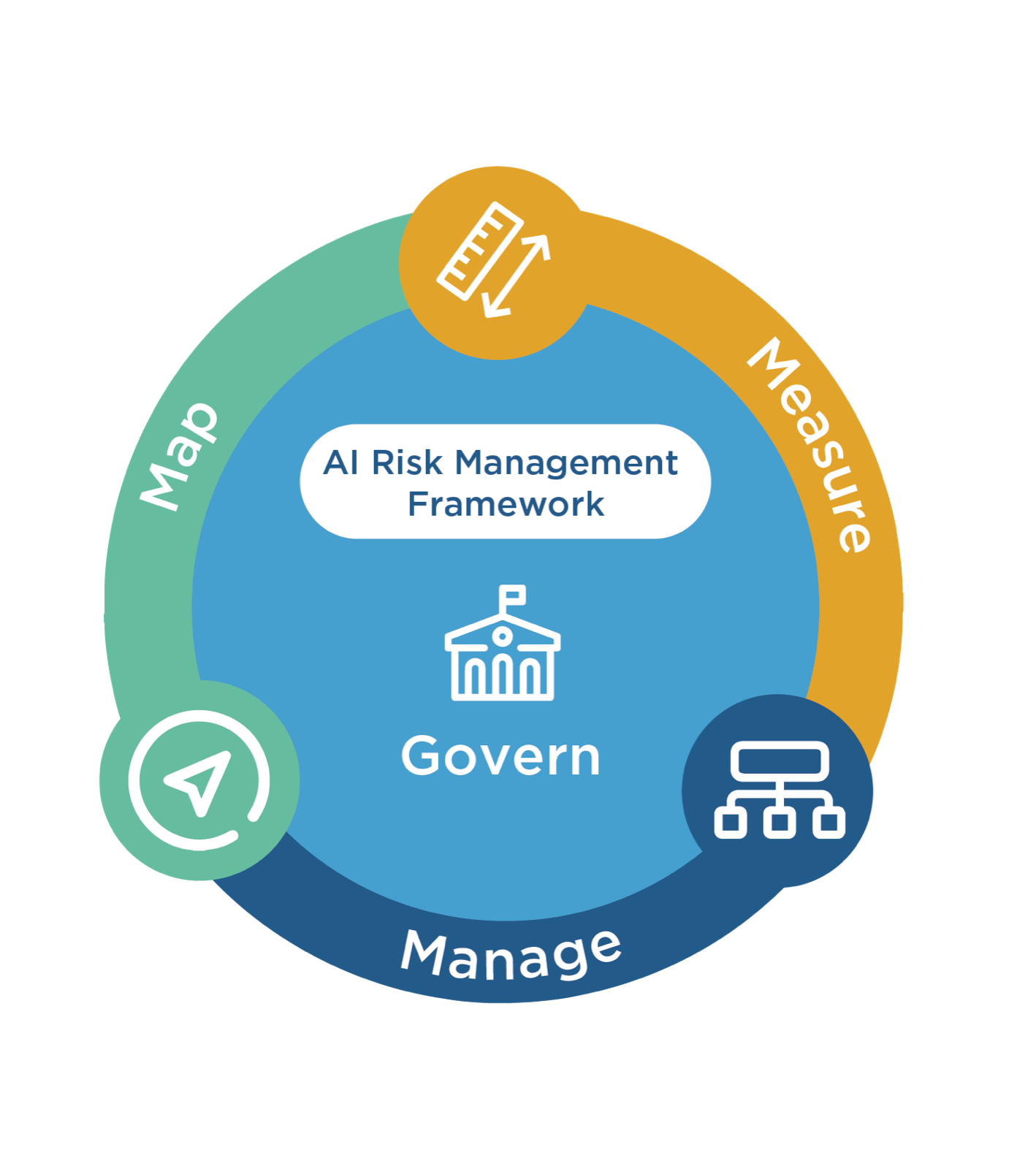
- Govern. Culture, policy, roles, accountability. Who decides, and who is on the hook.
- Map. Establish context. What AI systems do you actually run, who do they affect, and what is at stake.
- Measure. Analyze and track. Test the system, quantify the risk, keep testing.
- Manage. Act on what you measured. Put resources against the risks that matter, and monitor over time.
NIST is explicit that Govern is different in kind from the other three. In their words, it "is a cross-cutting function that is infused throughout AI risk management and enables the other functions of the process." Govern is organizational. Map, Measure, and Manage run at the level of each individual AI system.
Underneath sits NIST's definition of what "trustworthy" means: valid and reliable, safe, secure and resilient, accountable and transparent, explainable and interpretable, privacy-enhanced, and fair with harmful bias managed.
Read that list slowly and something uncomfortable surfaces. Nearly every item is a claim about the system in operation, not about a document describing the system. "Accountable" is not a paragraph in a policy. It is a name attached to a specific decision at a specific moment. "Secure and resilient" is not an intention. It is what happens when something unapproved tries to run.
The standards run behind your AI agents
If your understanding of NIST's AI work stops at the 2023 framework, you are missing the part aimed squarely at what your organization is doing right now.
- The Generative AI Profile (NIST AI 600-1, July 2024) maps generative-AI-specific risks onto the same four functions: confabulation, data privacy, harmful bias, intellectual property exposure.
- Control overlays for securing AI systems (the COSAiS project, concept paper August 2025) is NIST's effort to translate its long-standing SP 800-53 security controls into AI use cases. The planned overlays are revealing: adapting and using generative AI assistants, using and fine-tuning predictive AI, security controls for AI developers, and, notably, using AI agent systems, both single-AI agent and multi-agent.
- The Cyber AI Profile (draft NIST IR 8596, December 2025) brings AI into the Cybersecurity Framework, covering the security of AI systems, AI-enabled attacks, and AI-enabled defense.
- In February 2026, NIST's Center for AI Standards and Innovation launched an AI Agent Standards Initiative, aimed at interoperability, AI agent security, and agent identity.
Two things follow from that list.
First, the center of gravity has moved to AI agents, which is exactly where most organizations are now deploying. Second, and this is the part worth sitting with: the agentic overlays have not been drafted yet. The standards bodies are visibly behind the deployment curve. Your agents are running now. The control set written for them is not finished.
One more piece of housekeeping, since it comes up. The July 2025 White House AI Action Plan directed NIST to revise the AI RMF. NIST's page currently says the framework "is being revised." Present tense. As of this writing there is still no 2.0 and no published revision, so 1.0 remains the version anyone is actually working from.
The failure mode: attestation dressed as evidence
Here is where most implementations go wrong, and it is not for lack of effort.
A team reads the framework, correctly recognizes that it is a way of thinking rather than a control set, and does the reasonable thing: they translate it into documents. A policy for Govern. An inventory spreadsheet for Map. A test plan for Measure. A monitoring runbook for Manage. Then someone builds a readiness dashboard where each item is a checkbox, and updates it before the quarterly review.
Every one of those artifacts is a claim about reality rather than a measurement of it. The inventory was accurate the day it was written. The policy says irreversible actions require approval, but nothing stops one from happening without it. The dashboard says 78% ready, and nobody can tell you what the 78% is computed from, because it is computed from whether a person ticked a box.
The framework cannot fix this for you. NIST tells you Map means knowing what you run. It does not tell you how to know it is still true tomorrow.
Turning the functions into computed evidence
The alternative is to stop writing the evidence down and start producing it as a by-product of running the work. That requires governance to sit in the execution path, not beside it.
Concretely, it means every AI call passes through one governed surface, where:
- A model your organization has not approved does not run. Not "should not." Anything else in the path is denied. That is Govern, enforced, and it means your inventory of what can run is true by construction rather than by survey.
- Every governed action is recorded with who took it, what it touched, and who it was done for. Accountable owners are not assigned in a spreadsheet, they fall out of the record. That is Map, and Govern.
- Skills, tools, and packages are scanned before they are approved to run, and changes face a release gate they must meet or beat. That is Measure, on the release path rather than in a test plan.
- Spend, denials, and quality drift are tracked continuously against the same ledger an auditor would read. No side channel, no self-reported numbers. That is Manage.
- Irreversible actions never run when they are called: most wait for exactly one named human, and the rest only a signed-in person can run. That is human oversight as a mechanism instead of a promise.
This is the operating model we built into ALOS, organized as five phases we call SCOPE. It maps onto the framework deliberately:
- Situate (Map)
- You cannot govern what you cannot see. Inventory every AI system, with a named owner and its exposure.
- Challenge (Measure)
- Find the failure before it finds a customer. Evals, fairness slice tests, adversarial scans, red lines.
- Organize (Govern)
- Make good decisions repeatable. Roles, approval tiers, policies backed by controls that enforce them.
- Prove (Govern)
- If it is not documented, it did not happen. Model cards and crosswalks drawn from platform records.
- Embed (Manage)
- Launch it, then keep it alive. A scorecard fed from live data, and the loop back to Situate.
The difference that matters is not the table. Anyone can draw a table. It is that each phase gate is a computed readiness check rather than a checkbox. "Every system inventoried with a named accountable owner" is not something you assert. It is evaluated against your live project data, and it is either met or it is not. Fix the underlying control and the gate clears itself. Nobody can tick it into a green state.
What this does not mean
A few things worth saying plainly, because this space is full of vendors who blur them.
There is no NIST AI RMF certification. Mapping a program to the four functions is a claim about structure. It is a useful, honest claim. It is not an audit result, and we do not present it as one.
Coverage is not conformance. NIST names 72 subcategories across the four functions. ALOS evidences twelve of them today. We report coverage against all 72 and name the sixty we do not measure, because those remain the organization's to satisfy and a percentage computed from a flattering denominator is worse than no percentage at all.
A framework is not a control. The AI RMF will never stop an unapproved model from running. Only a mechanism does that. If an AI governance program consists entirely of documents describing controls, that is documentation, not governance.
Where to start, whatever size you are
Start with Map, and be honest about it. Not because it is easiest, but because everything downstream is fiction without it. You cannot test what you have not inventoried, you cannot monitor what you did not know was running, and you cannot put a name on a decision nobody recorded.
If you are small, this is a genuinely good week to do it. The list is short, the answer fits on a page, and building the habit now costs almost nothing. Retrofitting it across forty teams in two years costs a great deal.
If you are large, resist the urge to start with the policy. The policy is the easy part and the least load-bearing. Start by finding out what is actually running, because the gap between what your policy says and what your organization does is the entire risk.
Here is the good news for both: an inventory built from the execution path is not a survey you have to run. If every AI call has to pass through one governed surface, the list of what runs is not something you assemble once a quarter. It is something you already have.
Then the next time a customer, a partner, or your own board asks you to prove it, the answer is a query.
ALOS is TEKIMAX's AI governance control plane: one governed gateway for every AI agent, where only approved models run, skills are reviewed and promoted by a named person, irreversible actions never run when they are called, and every call is attributed, audited, and metered. [Request a walkthrough](/#contact).
References
Every factual claim above traces to one of these. Where a date or figure is stated, it comes from the primary source unless noted.
- 1. AI RMF 1.0 published January 26, 2023; intended for voluntary use; no certification program; Govern is cross-cutting; the trustworthy-AI characteristics
- NIST AI 100-1 / AI RMF and the AI RMF core
- 2. Small and medium organizations "may face different challenges than large organizations, depending on their capabilities and resources"
- NIST AI RMF, framing risk
- 3. 40% of enterprise applications will feature task-specific AI agents by end of 2026, up from under 5% in 2025
- Gartner press release, August 26, 2025
- 4. 69% of organizations suspect or have evidence of prohibited public GenAI use; 40%+ of enterprises to see a shadow-AI incident by 2030 (Gartner survey of 302 security leaders)
- Infosecurity Magazine, November 2025
- 5. Shadow AI a factor in roughly 1 in 5 breaches, adding about $670,000 to average breach cost
- IBM, Cost of a Data Breach Report 2025
- 6. Buyers asking vendors to "prove and demonstrate AI compliance"
- Vanta, AI Security Assessment
- 7. Generative AI Profile (NIST AI 600-1), July 2024
- NIST AI 600-1
- 8. Control overlays for securing AI systems, including single-AI agent and multi-agent use cases, not yet drafted
- NIST COSAiS project
- 9. Cyber AI Profile, preliminary draft NIST IR 8596, December 2025
- NIST CSRC
- 10. AI Agent Standards Initiative, February 2026
- NIST CAISI
- 11. The AI RMF has 72 subcategories (GOVERN 19, MAP 18, MEASURE 22, MANAGE 13)
- NIST AI RMF core
As of publication, AI RMF 1.0 remains the current version. NIST's framework page states that it "is being revised" following the July 2025 White House AI Action Plan; no revised text has been published.
Framework diagram credit: N. Hanacek/NIST, used per NIST's public-domain terms. TEKIMAX is not affiliated with, sponsored by, or endorsed by NIST, and this post is not a NIST publication.